Integral representations of the reciprocal beta function
Integrating a suitable branch of a complex power around a contour gives a useful representation of the reciprocal beta function. We will derive the identity below and then differentiate related formulas to obtain logarithmic integrals:
We will first prove this for real parameters satisfying \(\beta + 1>\alpha>0\). An analytic-continuation argument at the end will show that the identity actually holds for every real \(\alpha>0\) and every complex \(\beta\). Here \(B(x,y) = \frac{\Gamma(x)\Gamma(y)}{\Gamma(x+y)}\) is the Beta function.
The idea is to integrate the principal branch of \(f(z) = (1-z^2)^{\alpha-1} (-iz)^{\beta - \alpha}\) around the following contour:
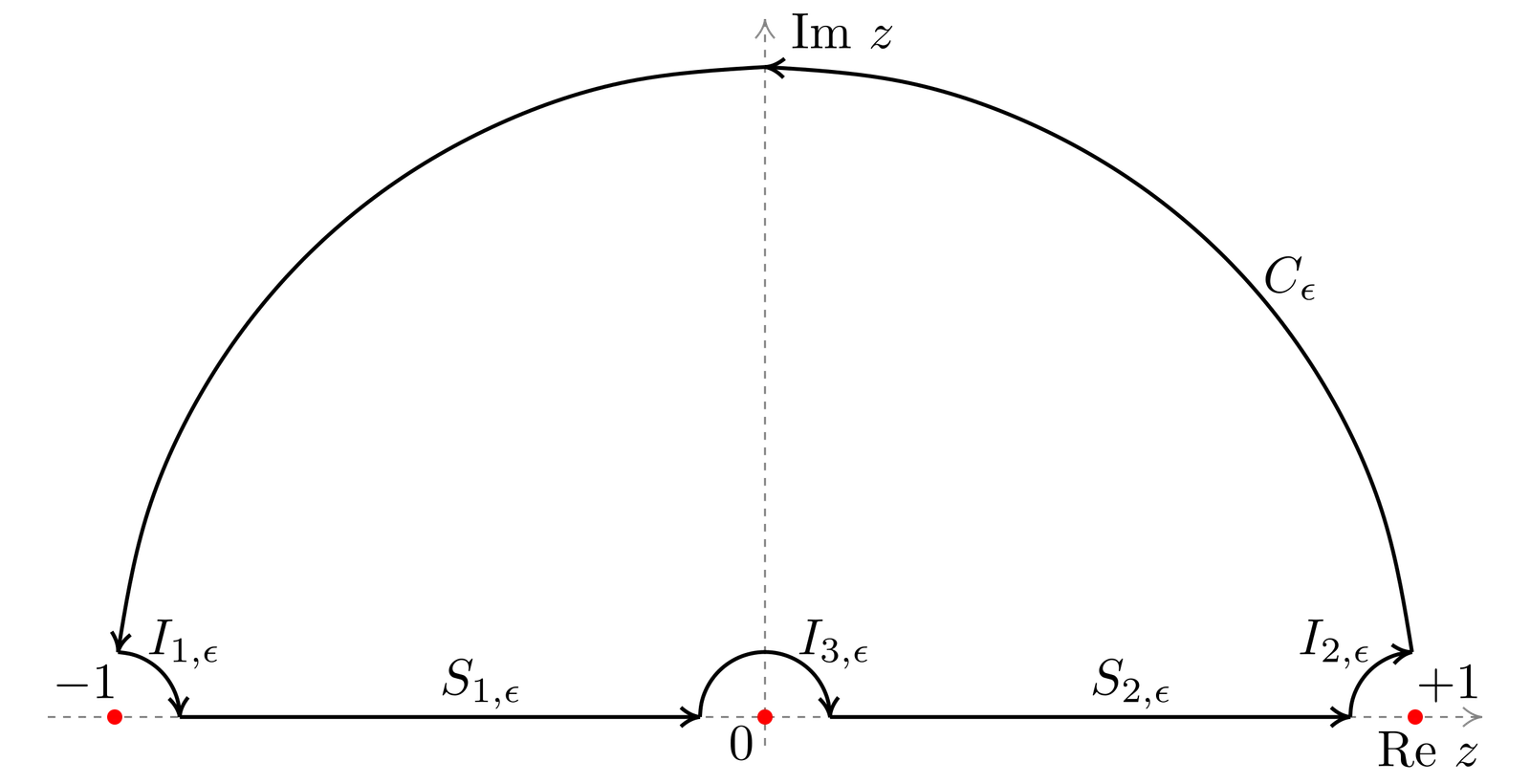
where
- \(C_\epsilon\) is an arc parameterized by \(e^{it}\), where \(\varphi_\epsilon\leq t \leq \pi - \varphi_\epsilon\) and \(\varphi_\epsilon = \text{arctan}\left( \frac{\epsilon \sqrt{4-\epsilon^2}}{2-\epsilon^2}\right)\).
- \(I_{1,\epsilon}, \; I_{2,\epsilon}, \; I_{3,\epsilon}\) are circular indents of radius \(\epsilon\) around the branch points -1, 1 and 0, respectively.
- \(S_{1,\epsilon}\) is a line joining \(-1+\epsilon\) and \(-\epsilon\).
- \(S_{2,\epsilon}\) is a line joining \(\epsilon\) and \(1-\epsilon\).
The condition \(\beta + 1 > \alpha > 0\) ensures that:
We'll only prove that the integral around \(I_{3,\epsilon}\) tends to 0 as \(\epsilon \to 0^+\). The proof is quite similar for \(I_{1,\epsilon}\) and \(I_{2,\epsilon}\). We have
For \(0<\epsilon<1\) we have
we must distinguish the sign of the exponent \(\alpha-1\). More precisely,
Therefore,
As \(M_\alpha(\epsilon)\to1\), the indentation integral tends to zero whenever \(\beta-\alpha+1>0\). Next, by Cauchy's theorem we have:
The integral on the left hand side is:
The integral on the right hand side is:
Therefore, we have:
We can use a similar technique to show that:
Removing the restriction on \(\beta\)
We now make the analytic-continuation argument precise. Fix a real \(\alpha>0\) and define
The function \(F_\alpha\) is entire in \(\beta\). Indeed, on every compact set of \(\beta\)-values, the integrand and each of its derivatives with respect to \(\beta\) are bounded by a constant times the integrable function \((\cos u)^{\alpha-1}\). Thus differentiation under the integral sign is valid to every order.
On the other hand, put
This is also entire in \(\beta\), because \(1/\Gamma(z)\) is an entire function. The contour argument above proves \(F_\alpha(\beta)=G_\alpha(\beta)\) for every real \(\beta>\alpha-1\). This set has accumulation points in the complex plane, so the identity theorem gives
Multiplying by \(e^{i\pi\beta/2}\) proves the original formula without the condition \(\beta+1>\alpha\). Notice that the integral on the left still converges for every complex \(\beta\) when \(\alpha>0\); it is only the auxiliary beta integral along the real diameter that required the original restriction. The apparent poles on the right are harmless: when one of the gamma factors has a pole, its reciprocal is zero.
The same identity is holomorphic in \(\alpha\) on the half-plane \(\operatorname{Re}(\alpha)>0\). Applying the identity theorem once more, now with \(\beta\) fixed and \(\alpha\) as the variable, extends the result to every complex \(\alpha\) with \(\operatorname{Re}(\alpha)>0\).
A lower-half-plane contour
There is a useful companion proof obtained by closing the contour in the lower half-plane. We cannot use exactly the same powers without crossing their branch cuts, so instead take principal branches in
Use the lower unit semicircle, with the same small indentations at \(-1\), \(0\), and \(1\). For real \(\alpha>0\) and \(\beta<1-\alpha\), the endpoint indentations are again \(O(\left(\epsilon^\alpha\right))\), while the indentation around the origin is
and hence all three vanish. On the real diameter,
Take the diameter from \(-1\) to \(1\) and then traverse the lower arc from \(1\) back to \(-1\). Parameterizing that arc by \(z=e^{-it}\) with \(0<t<\pi\) gives
Cauchy's theorem therefore yields the same integral representation as before. This lower contour proves it directly in the second range \(\beta<1-\alpha\), whereas the upper contour proves it for \(\beta>\alpha-1\). If \(0<\alpha<1\), these two ranges together cover the entire real \(\beta\)-axis. When \(\alpha=1\), they cover every real \(\beta\) except \(\beta=0\), which follows immediately by continuity (or direct evaluation). For \(\alpha>1\) there remains a gap \(1-\alpha\leq\beta\leq\alpha-1\), so the identity-theorem argument is still the clean way to obtain the unrestricted result.
Many interesting logarithmic integrals can be derived using these identities by differentiating both sides with respect to the parameters \(\alpha\) and \(\beta\). One such example is: