A trigonometric integral via a semicircular contour
Integrals containing nested inverse trigonometric functions often simplify dramatically after a change of variables that unwraps the inner function, followed by a passage to the unit circle in the complex plane. We will prove that for every \(n \in \mathbb{N}\),
Unwrapping the inverse sine
Let \(I\) denote the integral. We begin with the substitution \(\sin t = \frac{\sin x}{\sqrt{2}}\), so that \(\cos t\,dt = \frac{\cos x}{\sqrt{2}}\,dx\). Since \(\cos x = \sqrt{1 - 2\sin^2 t} = \sqrt{\cos(2t)}\) and \(t\) runs from \(0\) to \(\frac{\pi}{4}\) as \(x\) runs from \(0\) to \(\frac{\pi}{2}\), the factor \(\sqrt{1 - \frac{\sin^2 x}{2}} = \cos t\) cancels against \(\cos t\,dt\):
Next, substitute \(\theta = 2t\) and use the evenness of the integrand on \(\left[-\frac{\pi}{2}, \frac{\pi}{2}\right]\):
Integrating around the right half of the unit disk
Now integrate the principal branch of
around the positively oriented contour in the right half-plane shown below:
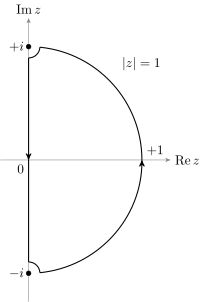
The contour consists of the right half of the unit circle \(|z|=1\) (\(-\frac{\pi}{2} < \arg z < \frac{\pi}{2}\)), the segment of the imaginary axis between \(+i\) and \(-i\), and two small circular indents of radius \(\epsilon\) avoiding the branch points at \(z = \pm i\). Near \(z = \pm i\), we have \(|1+z^2| = |z-i||z+i| \sim 2\epsilon\), so \(|f(z)| = O(\epsilon^{-1/2})\) while the arc length of each indent is \(O(\epsilon)\). Thus the integrals along both indents are \(O(\epsilon^{1/2})\) and vanish as \(\epsilon \to 0^+\).
Since \(f(z)\) is analytic inside the indented region, Cauchy's theorem equates the integral over the right semicircle to the integral upwards along the imaginary axis from \(-i\) to \(+i\). Parameterizing the imaginary axis by \(z = iy\) with \(y \in (-1, 1)\) and \(dz = i\,dy\) gives
Notice that when \(n = 2k+1\) is odd, \(i^n = i(-1)^k = i\sin\left(\frac{n\pi}{2}\right)\), whereas when \(n\) is even, \(\sin\left(\frac{n\pi}{2}\right) = 0\). Hence, for every \(n \in \mathbb{N}\), equation (2) can be written in the unified form
Parameterizing the semicircular arc
On the right unit semicircle, set \(z = e^{i\theta}\) for \(-\frac{\pi}{2} < \theta < \frac{\pi}{2}\), with \(dz = i e^{i\theta}\,d\theta\). Since \(1 + e^{2i\theta} = 2e^{i\theta}\cos\theta\) and \(\cos\theta > 0\) on \(\left(-\frac{\pi}{2}, \frac{\pi}{2}\right)\), the principal square root is \(\sqrt{1+e^{2i\theta}} = \sqrt{2\cos\theta}\,e^{\frac{i\theta}{2}}\). Therefore,
Combining equations (1), (2'), and (3), and finally setting \(\xi = y^2\) (\(d\xi = 2y\,dy\)) to reduce the remaining integral to Euler's beta function \(B\left(\frac{n}{2}, \frac{1}{2}\right)\), we conclude that