The Fourier transform of the hyperbolic secant
A classic property of the hyperbolic secant \(\operatorname{sech}(\pi x) = \frac{1}{\cosh(\pi x)}\) is that, like the Gaussian, it is an eigenfunction of the Fourier transform. We will prove that for \(a > 0\),
Since \(\cosh(\pi x)\) is an even function, the imaginary part \(\int_{-\infty}^\infty \frac{\sin(ax)}{\cosh(\pi x)}\,dx\) vanishes by symmetry, so the formula is symmetric in \(a\) and holds for all real \(a \in \mathbb{R}\).
Method 1: An expanding rectangular contour
Let \(f(z) = \frac{e^{iaz}}{\cosh(\pi z)}\). The poles of \(f(z)\) occur where \(\cosh(\pi z) = 0\), namely at
all of which lie on the imaginary axis with spacing \(i\). For each positive integer \(N \in \{1, 2, \dots\}\), define \(B_N\) to be the positively oriented rectangle with vertices \(-N\), \(N\), \(N+iN\), and \(-N+iN\):
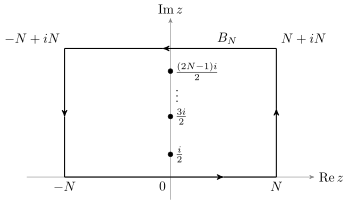
Choosing the top edge at height \(\operatorname{Im} z = N\) ensures that the contour passes halfway between the poles \(z_{N-1} = \left(N-\frac{1}{2}\right)i\) and \(z_N = \left(N+\frac{1}{2}\right)i\), enclosing exactly the \(N\) simple poles \(z_0, z_1, \dots, z_{N-1}\).
At \(z_n = \frac{(2n+1)i}{2}\), we have \(\frac{d}{dz}\cosh(\pi z)\big|_{z=z_n} = \pi\sinh\left(i\pi\left(n+\frac{1}{2}\right)\right) = \pi i (-1)^n\), so the residue is
Applying the residue theorem to \(B_N\) and taking \(N \to \infty\) gives a convergent geometric series (since \(a > 0\) implies \(e^{-a} < 1\)):
To verify that only the integral along the bottom edge \([-N, N]\) survives as \(N \to \infty\), we estimate the other three sides:
- Top edge (\(z = x + iN\), \(-N \leq x \leq N\)): Since \(\cosh(\pi(x+iN)) = (-1)^N\cosh(\pi x)\) and \(|e^{ia(x+iN)}| = e^{-aN}\),
- Vertical edges (\(z = \pm N + iy\), \(0 \leq y \leq N\)): By the reverse triangle inequality, \(|\cosh(\pi(\pm N + iy))| \geq \sinh(\pi N)\), while \(|e^{ia(\pm N + iy)}| = e^{-ay} \leq 1\), so
Consequently,
Method 2: A fixed-height strip enclosing a single pole
We can also avoid summing an infinite series of residues by using a rectangle \(\Gamma_R\) of fixed height \(1\) with vertices \(-R\), \(R\), \(R+i\), and \(-R+i\). Since \(\cosh(\pi(x+i)) = -\cosh(\pi x)\), the top edge is a constant multiple of the bottom edge:
The vertical sides are bounded by \(\frac{1}{\sinh(\pi R)} \to 0\) as \(R \to \infty\), and \(\Gamma_R\) encloses only the single pole at \(z_0 = \frac{i}{2}\). The residue theorem then gives
which immediately divides through to \(\frac{1}{\cosh(a/2)}\) for every \(a \in \mathbb{R}\) (and, by analytic continuation, for every complex \(a\) in the strip \(|\operatorname{Im} a| < \pi\)).